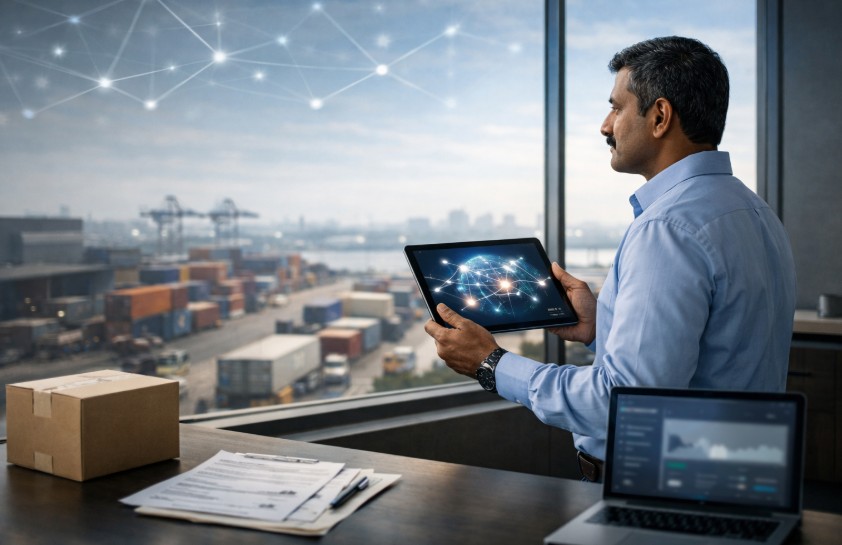
India is one of the countries with the largest SME sector. And as the International Finance Corporation (IFC) reports, the country has approximately 63 million MSMEs, which contribute around 30% of its GDP.
At the same time, these enterprises, surprisingly, account for more than 40% of the country’s exports. And for many of them, international trade is a dream filled with opportunity.
But despite the multiple expansion opportunities, the international market also has its challenges, with one of the main ones being cross-border payments.
Do you actually know that, according to Gitnux, over seven in ten SMEs have withdrawn from international contracts just because of cross-border payment issues? This comes at a time when half of small businesses cite high fees as the biggest challenge in global payments.
Thankfully, technologies like blockchain can actually help address these challenges. Of course, to some, this might come as a surprise, mainly because blockchain was initially associated with cryptocurrencies.
But even when you look at crypto prices today, you’ll notice that this technology has evolved far beyond speculation. Take the BTC price INR, for instance.
According to crypto exchange Binance, 1 BTC is equivalent to about 8,348,692 INR as of January 5, 2026, signalling that the underlying blockchain tech is proving its true worth, even in cross-border payments.
Even Catherine Chen, Binance Head of VIP & Institutional, agrees, saying that “Crypto is no longer a niche asset class and it is increasingly becoming integrated into everyday financial services.”
How Can Blockchain Reshape Cross-border Payments for Indian SMEs?
Reducing Transaction Costs

As already mentioned, high fees are one of the biggest challenges affecting many SMEs. Remember, these enterprises are already grappling with high operational costs.
So, when you add the exuberant transaction costs of global trade to that equation, it’s easy to see why international expansion often feels like trying to run a marathon with ankle weights. Imagine the pain of spending up to 6-7% of every single transaction just on fees.
For an SME sending $10,000 abroad, that’s over $600 vanishing before the product even reaches the customer. Such funds could have gone into other operations, such as hiring more staff or even upgrading equipment.
Blockchain, however, flips this script. It cuts out multiple intermediaries and automates settlements, which could, in turn, slash transaction costs by up to 80%.
Since blockchain is decentralised, it verifies and records transactions by itself. In this way, you won’t need to rely on numerous banks and clearinghouses to process a payment. And when there are no third parties, the fees dramatically drop.
Speeding Up Cross-border Transactions
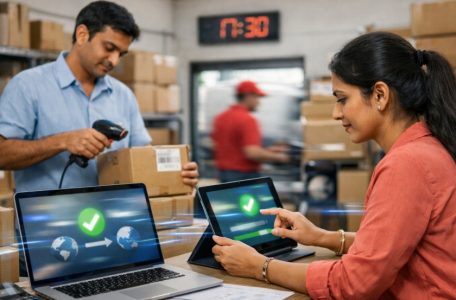
If you’ve ever sent money internationally, you know how painful slow processes can be. In fact, usually, many users tend to abandon transactions altogether when they realise payments can take ages to settle.
Looking at the statistics, Testlio attributes a 20% decline in conversion rates to slow transaction processes. Elsewhere, Future Market Insights forecasts that the global instant payment market size will jump from $37.8 billion in 2025 to $159.5 billion by 2035.
These statistics alone prove that the world is quickly transitioning to fast payment methods, and India is no exception. You may actually be surprised to learn that, according to Markets and Data, India’s real-time transaction market could expand by a 22.58% CAGR within the next few years.
Of course, if you want to remain competitive in such a market, you can’t ignore these statistics. This is why blockchain-based payments could form an ideal foundation for future cross-border transactions among Indian SMEs.
By eliminating third parties, blockchain not only reduces costs but also improves speed. The absence of a chain of banks and intermediaries means funds no longer have to crawl through multiple approval layers or reconciliation processes.
Instead, payments can be settled in near real-time, giving businesses access to working capital and the agility they need to compete confidently on the global stage.
More robust networks like Solana ensure the transaction processes remain seamless even during peak seasons. Think about it: Solana alone can support over 60,000 transactions per second! For an SME looking to scale globally, that kind of speed can be the difference between grabbing an opportunity and watching it slip away.
The Transparency and Trust Issue

With cyberattacks becoming so popular, no one wants to do business with an insecure brand. In fact, a good number of customers turn away from a brand after hearing reports of its prior involvement in a data breach.
For SMEs, this means building trust across all your payment systems can be a make-or-break factor for international growth. And since blockchain’s decentralisation can improve online security, more Indian enterprises could adopt it to appeal to security-conscious buyers.
This decentralised technology could also improve trust by enhancing transparency. It stores data in a way that everyone on the network can access it.
So, when someone initiates a transaction, you can always view it in real-time. At a time when Swift says 70% of customers may stop using a payment provider if they encounter hidden fees, such transparency can be really handy.
When you combine all these advantages, it becomes difficult to envision the future of Indian SMEs without blockchain. For instance, individuals today expect payment processes to be as fast as possible.
If they experience delays or unclear transaction details, their trust erodes, which can be very detrimental to your business. But since decentralised systems make transactions traceable, more companies could turn to them to meet the growing demand for fast, secure and low-cost transactions.